The North Pennines National Landscape team and the Yorkshire Dales National Park Authority are delighted to announce the farms that have been awarded the Tees-Swale: naturally connected High Nature Value Farming Awards for 2024.
The Tees-Swale: naturally connected programme is led by the North Pennines National Landscape team in partnership with Yorkshire Dales National Park Authority and funded by The National Lottery Heritage Fund using money raised by National Lottery players.
The programme is working in collaboration with farmers and land managers across 845 km² of the northern Pennines to deliver improved connectivity and biodiversity across this unique upland landscape.
The High Nature Value Farming Awards celebrate those farmers in the region who represent a wider field of excellence and are using nature-friendly practices to enhance the area for the future. There are three award categories: high nature value best practice, nature recovery and public engagement, with the gold winning farms receiving a prize of £500 each, funded by The National Lottery Heritage Fund. The award nominations were judged by a panel, led by Professor Sir John Lawton, Chair of the Tees-Swale programme board, with Cat Kilner of the North Pennines National Landscape team, and Neil Heseltine from Hill Top Farm, Malham. The awards were presented by Sir John Lawton at the Moorcock Inn, Eggleston, on Wednesday 16 October after a farming and nature talk by Neil Heseltine.
“The standard of nominations for the 2024 Tees-Swale High Nature Value Farming Awards was incredibly high, which is why we have decided for the first time to award gold and silver awards for outstanding practices in the area.
These awards are to celebrate all those who manage and farm the land in Teesdale and Swaledale with nature in mind. It is not just the winners, or even just those nominated, who we want to acknowledge for their dedication towards improving habitats in this region. I have been inspired by the work that farmers are doing and know that this part of the uplands is in good hands for future generations.
Through the generosity of The National Lottery Heritage Fund we are able to recognise farmers’ efforts in striving to make the North Pennines National Landscape and Yorkshire Dales National Park a better place to live, work and visit.”
Sir John Lawton
The high nature value farming category aims to highlight farms which have consistently shown best practice. Often the people rewarded are those that have made significant changes, but this award celebrates those who have always farmed less intensively and who have a long track record of high nature value farming best practice. The winners of the high nature value farming best practice award, for the constant attention to detail, thoughtful approach and continuing enhancement of the farm and its habitats, are Paul and Jen Johnson of Herdship, Upper Teesdale.
Herdship is dominated by its altitude, ranging from 1,500 to 1,700 feet high. Both cattle and sheep graze these traditional upland pastures to create a diverse habitat for breeding waders. Herdship is traditionally farmed and managed to ensure the survival of black grouse, a species that has only 1,000 breeding pairs across England, and is a great place to see these rare birds. Recently Paul and Jen have worked to reduce the use of wormers in their livestock, benefiting invertebrates and birds whilst also reducing costs. The judges agreed with the comment Herdship is not special because of what they do, but because of what they don’t do.
The nature recovery category is about a farm that has transformed the way it is managed, turning it into a place where nature has a chance to thrive once more. The gold winner of the nature recovery award, for the continuing transformation of this farm, is Julia Carr of Marrick Park, Swaledale.
Julia Carr has worked to improve the land at Marrick Park for wildlife since 2009. Grazing has transitioned from predominately sheep to pedigree highland cattle that are fed a 100% grass diet, and works have taken place to restore and enhance several hay meadows. A particular focus has been trees with a desire to link up the existing areas of woodland around the farm. There has also been a trial of disease resistant elm species.
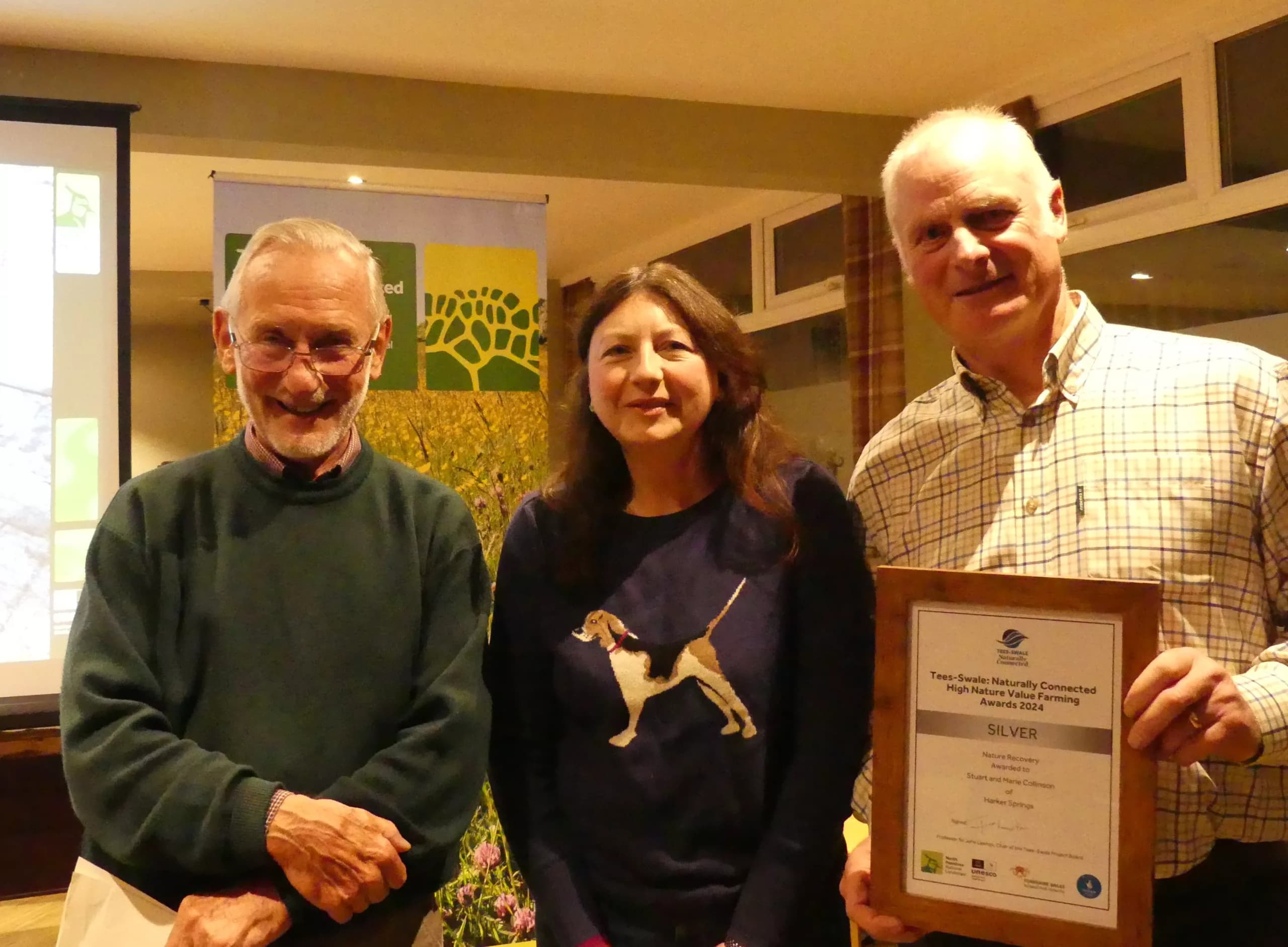
The silver winners are Stuart and Marie Collinson, of Harker Springs, Lunedale. The judging team were impressed with the work to restore upland hay meadows and diversify woodland shelterbelts at Harker Springs.
Stuart grew up at Harker Springs, which used to run as a dairy unit until roughly 25 years ago. They are now running both cattle and sheep and have begun enhancing nature on several areas of the holding. Two large hay meadows have been restored using green hay; the first of these was so successful that it was able to be used in the restoration of the second. Last winter, with the help of the North Pennines National Landscape team works were carried out to diversify conifer shelterbelts opening up space for new trees by removing windblown trees and selective thinning and introducing native broadleaved species.
The public engagement category celebrates those farmers who are increasing the wider public understanding of farming and nature.
The gold winner of the public engagement award, for their track record and continued enthusiasm for engaging the general public with farming and nature, is Catherine Calvert from Hazel Brow Farm, Low Row, Swaledale.
Hazel Brow Farm first became a visitor destination 27 years ago when the Calvert family pioneered opening the farm to visits from the public. Hazel Brow provides a wide range of opportunities for public engagement, and a great venue for a range of events and activities. Educational opportunities are offered through the Countryside Stewardship scheme. Other groups have come via the Tees-Swale programme, including the Barnard Castle Families Hub and the Richmond & Catterick Neurodiverse group. This year they have refreshed their offer to the general public and held successful events celebrating Open Farm Sunday and National Meadows Day. The Hazel Brow team is passionate about, and has a long history of, engaging the public and is proud of the wildlife the farm supports.
The silver was awarded to Karen Scott from Low Way Farm for their ongoing commitment to public engagement.
Karen Scott at Low Way Farm diversified early. The first bunk barn was created here in 1998 to provide accommodation for people walking the nearby Pennine Way. Along with holiday cottages and the Farmhouse Kitchen café and catering business, the bunk barns contribute to the wider farm business with its flock of 200 ewes and its species-rich hay meadows. The farm now provides an excellent location for public engagement events and activities, including residential visits from cubs and scouts, Duke of Edinburgh Award groups, visits from schoolchildren and has hosted events celebrating National Meadows Day.
“The High Nature Value Farming Awards recognise the dedication of farmers in Teesdale and Swaledale to conserve and promote the diversity of habitats across the region. We believe it is vital that this work is promoted so that is valued not just by those who live in these areas but also by the wider public who also gain from the nature benefits it provides. We would like to thank National Lottery players, who support all of this vital work for nature and farming across two protected landscapes.”
Patrick Oulton, Tees-Swale Programme Manager with the North Pennines team